

The primary objective of analysing the service life of rolling bearings is to identify the main factors causing bearing failure, based on extensive background information, analytical data and failure modes, so as to propose targeted improvement measures to extend the service life of the bearings and prevent sudden premature failure.
The method of installing rolling bearings depends on the bearing fit, operating conditions and structure. Generally, as the shaft is usually rotating, the inner ring requires an interference fit. Bearings for cylindrical bores are typically pressed in using a press or fitted using a hot-fitting method. In the case of tapered bores, they are either mounted directly onto a tapered shaft or fitted using a sleeve.
Wear failure refers to failure caused by the continuous wear of metal on working surfaces resulting from relative sliding friction between surfaces. Continuous wear leads to the gradual deterioration of rolling bearing components, ultimately resulting in the loss of dimensional accuracy and other related issues. Wear may result in changes to the geometry, an increase in fitting clearance and alterations to the surface topography of the working surfaces. It may also affect the lubricant or contaminate it to such an extent that lubrication function is completely lost, thereby causing the bearing to lose its rotational precision or even become unable to operate normally. Wear failure is one of the most common failure modes for all types of bearings; depending on the form of wear, it is typically classified into the *most common types: abrasive wear and adhesive wear.
1. Thrust Angular Contact Ball Bearings
Thrust angular contact ball bearings generally have a contact angle of 60°. Commonly used thrust angular contact ball bearings are typically double-direction thrust angular contact ball bearings, primarily used in the spindles of precision machine tools. They are generally used in conjunction with double-row cylindrical roller bearings to withstand axial loads in both directions. They offer advantages such as high precision, good rigidity, low temperature rise, high rotational speed and ease of installation and removal.
Second: Deep-groove ball bearings
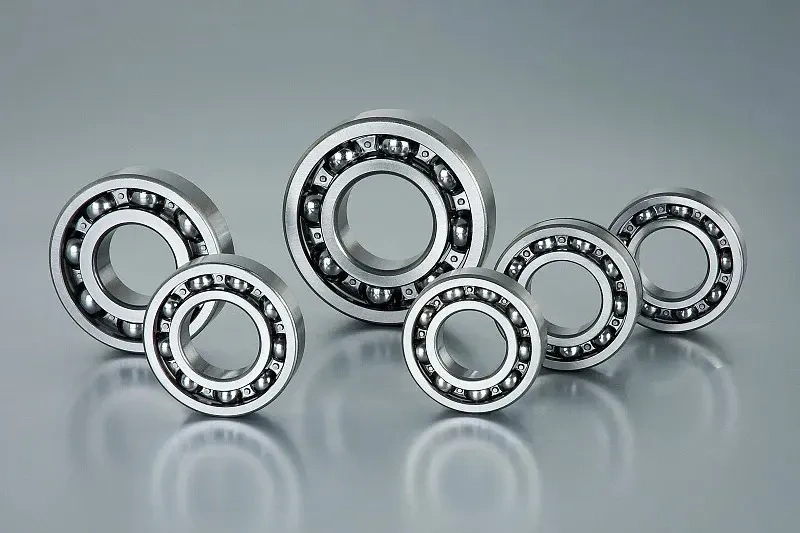
Structurally, each ring of a deep-groove ball bearing features a continuous grooved raceway whose cross-sectional length is approximately one-third of the equatorial circumference of the ball. Deep-groove ball bearings are primarily used to support radial loads, though they can also withstand a certain amount of axial load. When the radial clearance of the rolling bearing is increased, it exhibits the characteristics of an angular contact ball bearing and can withstand alternating axial loads in both directions. Compared with other types of bearings of the same dimensions, this type of bearing has a low coefficient of friction, a high limiting speed and high precision, making it the preferred choice for users when selecting bearings. Deep groove ball bearings are simple in structure and convenient to use; they are the most widely produced and most extensively applied type of bearing.
Third: Thrust Tapered Roller Bearings
As the rolling elements in thrust tapered roller bearings are tapered rollers, the rolling generatrices and the raceway generatrices of the rings intersect at a single point on the bearing’s centre line; consequently, the rolling surfaces can achieve pure rolling, resulting in a higher limiting speed than that of thrust cylindrical roller bearings. Characteristics: Thrust tapered roller bearings can withstand unidirectional axial loads. The type designation for thrust tapered roller bearings is the 90000 series.
Structure and Performance Characteristics of Double-Row Tapered Roller Bearings
Double-row tapered roller bearings come in a wide variety of designs; the most common is the 35000 series, which features a double-raceway outer ring and two inner rings, with a spacer between the two inner rings. The clearance can be adjusted by varying the thickness of the spacer. This type of bearing can withstand bidirectional axial loads whilst bearing radial loads, and can limit the axial displacement of the shaft and housing within the bearing’s axial clearance range. Structural characteristics of tapered roller bearings. The type designation for tapered roller bearings is 30000; tapered roller bearings are separable bearings. Tapered roller bearings are primarily used to support combined radial and axial loads, with the radial load being predominant. Compared to angular contact ball bearings, they have a higher load-carrying capacity but a lower limiting speed. Tapered roller bearings can withstand axial loads in one direction and can limit the axial displacement of the shaft or housing in that direction.
During operation, rolling bearings may experience changes in their original clearance and a reduction in precision due to external or internal factors, which can even lead to ‘seizing’; this is known as clearance variation failure. External factors such as excessive interference fit, incorrect installation, thermal expansion caused by temperature rise, and momentary overloads, as well as internal factors such as residual austenite and residual stresses in an unstable state, are the primary causes of clearance variation failure.
The anti-rust oil applied to bearings possesses good lubricating properties; for general-purpose bearings or those filled with grease, it is not necessary to clean them before use. However, for instrument bearings or those intended for high-speed rotation, the anti-rust oil must be removed using a clean washing oil; at this stage, the bearings are susceptible to rust and must not be left standing for long periods.
Clean the bearings and housings, ensuring there are no scratches or burrs left from machining. The interior of the housing must be completely free of abrasives (such as SiC or Al₂O₃), moulding sand, swarf and other debris.
The manufacture of rolling bearings generally involves multiple processing stages, including casting, heat treatment, turning, grinding and assembly. The rationality, sophistication and stability of each machining process also affect the service life of the bearing. Among these, the heat treatment and grinding processes—which influence the quality of the finished bearing—often have a more direct relationship with bearing failure. Recent research into the altered layers on bearing working surfaces has shown that there is a close relationship between the grinding process and the surface quality of the bearing.

Linqing Hengbo Bearing Co., Ltd. is located in Linqing, Shandong, a bearing industry base. It is a modern bearing manufacturing enterprise that integrates research and development, manufacturing, sales, and comprehensive management, specializing in the production of medium and large-sized Class 0 deep groove ball bearings.
Copyright © 2025.Linqing Hengbo Bearing Co., Ltd All rights reserved.