

Bearing stiffness is an important performance indicator. Stiffness is not only related to load and rotational speed, but also to frictional heat and the preload method. Stiffness calculations also form the basis for analysing the dynamic characteristics of spindle units.
I. The Influence of Preload Methods and Rotational Speed
Under constant-pressure preload, the radial stiffness of the bearing increases slightly as the rotational speed rises, whilst the axial and angular stiffness decrease rapidly. Under locating preload, the radial, axial and angular stiffness of the bearing all increase rapidly with rising rotational speed, although the increase in axial and angular stiffness is relatively gradual. The patterns of stiffness variation in ceramic ball bearings are similar to those of all-steel bearings, but the changes are more gradual. Under locational preload, the centrifugal forces acting on the inner ring and balls, together with the effects of frictional heat, increase the contact load on the inner and outer rings. At the same time, the contact angle of the outer ring decreases whilst that of the inner ring increases, thereby increasing the contact stiffness; however, the reduction in the outer ring’s contact angle slows the increase in axial and angular stiffness.
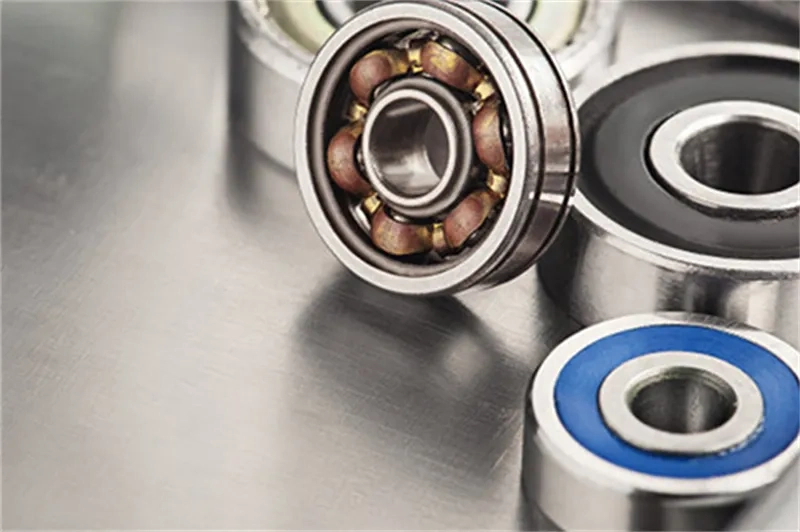
Under constant-pressure preload, the increased centrifugal force on the balls causes the contact load on the outer ring to rise, whilst the contact angle decreases. As axial displacement is permitted in both the inner and outer rings, the contact load on the inner ring remains essentially unchanged, but the contact angle increases. Thermal displacement and centrifugal displacement have virtually no effect on the contact loads or contact angles of the inner and outer rings. Although the normal contact stiffness of the outer ring increases, that of the inner ring remains essentially unchanged; the combined effect results in a slight increase in radial stiffness, though this is not significant, whilst the reduction in the outer ring’s contact angle leads to a significant decrease in axial and angular stiffness. Under locating preload, the stiffness of ceramic ball bearings is lower than that of all-steel bearings, whereas under constant-pressure preload, the stiffness of ceramic ball bearings is higher than that of all-steel bearings. Under positional preload, the contact load of all-steel bearings is more than double that of ceramic ball bearings; despite the high elastic modulus of ceramic balls, the stiffness of all-steel bearings is greater than that of ceramic ball bearings. Under constant-pressure preload, however, the inner ring contact load remains largely unchanged, and the high elastic modulus of the ceramic balls results in ceramic ball bearings having greater stiffness than all-steel bearings.
1. The effect of preload
As the preload increases, the radial, axial and angular stiffness of the bearing increase slightly, but the effect is minimal. Compared with positioning preload, this effect is more pronounced under constant-pressure preload. This is because an increase in preload causes the contact angle between the inner and outer rings to increase, whilst simultaneously increasing the contact load, thereby leading to a slight increase in radial, axial and angular stiffness. However, the changes in contact load and contact angle caused by the preload are smaller than those caused by rotational speed and component displacement; consequently, the effect on bearing stiffness is limited. This also explains why the changes under positional preload are smaller than those under constant-pressure preload.
2. Effect of raceway radius of curvature
As the radius of curvature of the inner and outer raceways increases, the radial, axial and angular stiffness decrease accordingly; however, this effect is negligible, with the change in stiffness being only slightly more pronounced under locational preload. This is because an increase in the raceway radius of curvature leads to greater contact deformation. Therefore, when selecting the raceway radius of curvature, its effect on stiffness can generally be disregarded.
3. The effect of the number of balls
Under positioning preload, an increase in the number of balls results in a slight increase in radial, axial and angular stiffness. Whilst an increase in the number of balls does increase stiffness, under the same preload, it also reduces the contact load; although the combined effect of these factors leads to an increase in bearing stiffness, the increase is minimal.
Under constant-pressure preload, an increase in the number of balls results in a marked increase in radial stiffness; however, when the rotational speed rises to a certain value, the axial and angular stiffness actually decrease, albeit by a very small amount. This is because, under constant-pressure preload, although an increase in the number of balls reduces the inner ring contact load, it simultaneously reduces the inner ring contact angle; the combined effect of these factors results in a marked increase in the bearing’s radial stiffness, whilst the axial and angular stiffness decrease slightly.
Therefore, when the number of balls is increased, the preload should be correspondingly increased; only when the contact load remains constant will an increase in the number of balls lead to an increase in bearing stiffness.
4. The Effect of Ball Diameter
Under locational preload, an increase in ball diameter results in a slight increase in radial, axial and angular stiffness. An increase in ball diameter increases the centrifugal force of the balls, reduces the outer ring contact angle and increases the inner ring contact angle; however, it simultaneously increases the contact loads on both the inner and outer rings. The combined effect of these factors results in an increase in bearing stiffness. As the effect of changes in centrifugal force on contact load is relatively minor under locational preload, the impact of changes in ball diameter on stiffness is negligible.
Under constant-pressure preload, an increase in ball diameter leads to a corresponding increase in radial stiffness, whilst axial and angular stiffness actually decrease, although the effect is minor. This is because an increase in ball diameter increases the centrifugal force acting on the balls, reduces the contact angles of the inner and outer rings, and increases the contact load on the outer ring, whilst the contact load on the inner ring remains essentially unchanged; consequently, radial stiffness increases, whilst axial and angular stiffness decrease slightly. Therefore, reducing the ball diameter not only improves speed performance but also does not compromise stiffness performance. This also provides theoretical proof that reducing ball diameter is one of the current trends in the development of spindle bearings.
5. The Effect of the Initial Contact Angle
Under locational preload, an increase in the initial contact angle results in a significant reduction in radial stiffness and a marked increase in axial and angular stiffness. This is because, as the initial contact angle increases, the radial component of the contact stiffness decreases whilst the axial component increases; simultaneously, the contact load decreases under the same preload.
Under constant-pressure preload, an increase in the initial contact angle results in a significant reduction in radial stiffness. At low speeds, axial and angular stiffness increase, whilst at high speeds, there is essentially no change. This is because, under constant-pressure preload, axial displacement of the inner and outer rings is permitted; to maintain force equilibrium, the outer ring contact angle is almost zero, and the magnitude of the initial contact angle has virtually no effect on the outer ring contact angle. Similarly, an increase in the initial contact angle reduces the contact load under the same preload.

Linqing Hengbo Bearing Co., Ltd. is located in Linqing, Shandong, a bearing industry base. It is a modern bearing manufacturing enterprise that integrates research and development, manufacturing, sales, and comprehensive management, specializing in the production of medium and large-sized Class 0 deep groove ball bearings.
Copyright © 2025.Linqing Hengbo Bearing Co., Ltd All rights reserved.