

The raceways of deep-groove ball bearing rings constitute the machined surfaces of the bearing; their quality directly affects the bearing’s operational performance and service life. During use, we frequently encounter common quality issues on the surfaces of bearing rings. How do these quality issues arise? Drawing on many years of experience, we will outline the common quality issues found on bearing ring surfaces and their underlying causes.
1. Poor surface roughness
Causes: Insufficient superfinishing time; excessive grinding wheel pressure; relatively high grinding wheel vibration frequency; and excessively low rotational speed of the workpiece during finishing and superfinishing.
2. Superfinishing nodules
These are protrusions of varying sizes and shapes that form on the machined surface after superfinishing. They are primarily caused by grinding particles sintering onto the machined surface under the influence of instantaneous high temperature and pressure. Their presence increases the bearing’s vibration levels and reduces its service life.
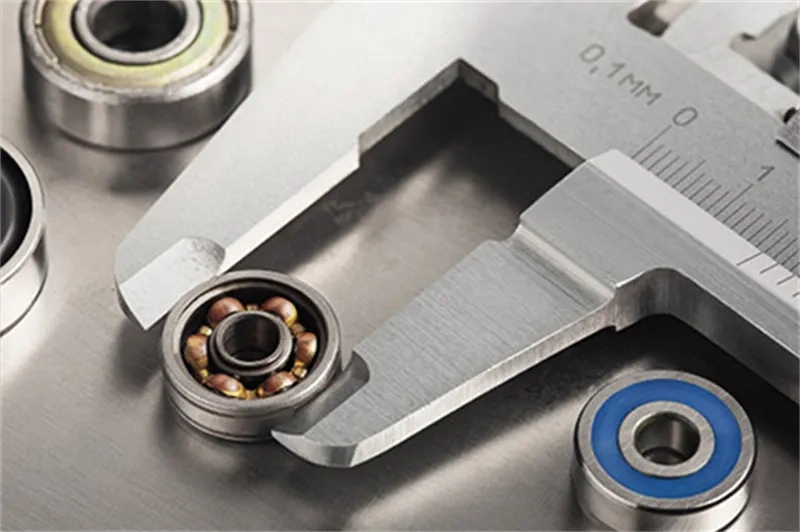
Causes: Excessive grinding wheel pressure. Excessively high surface roughness prior to superfinishing; excessive workpiece rotational speed; inadequate cooling of the cutting lubricant; and excessive residual magnetism from the grinding of the bearing rings.
3. Thread-like marks
A mesh-like pattern of scratches appearing on the machined surface after superfinishing.
Causes: Excessive impurities in the grinding wheel and uneven grain size; impurities in the cutting fluid and insufficient flushing.
4. Comet marks
During superfinishing, individual larger diamond particles detach or become lodged in depressions on the workpiece surface, forming comet marks as a result of the superfinishing pressure and the rotation of the workpiece.
Causes: Select the correct grinding wheel and reduce the grinding wheel pressure.
5. Grinding wheel marks
Causes: The grinding wheel marks are too coarse during the grinding of the machined surface; the workpiece rotational speed is too high during rough superfinishing; the rough superfinishing time is too short; the grinding wheel pressure is too low during rough superfinishing; and the grinding wheel swing angle is too small.
6. Excessive axial runout of the end face
Causes: Insufficient workpiece eccentricity, leading to unstable rotation and high radial runout; the centre of the grinding wheel’s oscillation does not coincide with the centre of curvature of the workpiece’s raceway; foreign matter on the end face support surface during workpiece positioning, resulting in excessive axial runout of the end face; poor geometric accuracy of the grinding process; and the workpiece having undergone multiple rework operations.
7. Poor roundness and waviness
Causes: Excessively small workpiece eccentricity; excessive spindle speed during finishing and super-finishing, causing machine vibration; insufficient grinding wheel width and too small an angle of coverage; too small a support angle during roller positioning, preventing normal rotation of the ring; excessive roundness and waviness in the grinding process.
8. Poor curvature of ball bearing raceways after superfinishing
Causes: The centre of oscillation does not coincide with the centre of curvature of the raceway; the grinding wheel is too wide and the wrap angle is too large.

Linqing Hengbo Bearing Co., Ltd. is located in Linqing, Shandong, a bearing industry base. It is a modern bearing manufacturing enterprise that integrates research and development, manufacturing, sales, and comprehensive management, specializing in the production of medium and large-sized Class 0 deep groove ball bearings.
Copyright © 2025.Linqing Hengbo Bearing Co., Ltd All rights reserved.