

The clearance of a bearing refers to the amount of movement when, prior to installation on a shaft or in a bearing housing, one of the inner or outer rings is fixed, and the unfixed ring is then moved radially or axially. Consequently, the measured value is greater than the actual clearance (known as the theoretical clearance), as it includes the elastic deformation caused by the measurement load. However, for deep-groove ball bearings, this elastic deformation is so small that it can be disregarded. The internal clearance of a bearing prior to installation is generally expressed as the theoretical clearance.
Bearing lubrication utilises an oil film to separate the relative moving rolling surfaces from one another, thereby preventing failure due to excessive wear caused by rough spot contact. If users attach great importance to the lubrication technology of deep groove ball bearings, they can ensure that stable performance and rotational accuracy are maintained throughout the bearing’s intended service life.
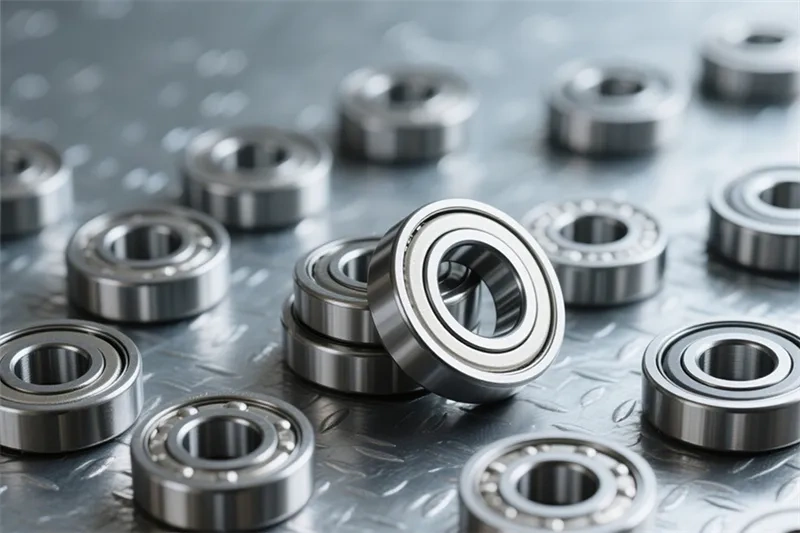
Rotate the outer ring and thoroughly rinse the cage, as well as the junctions between the rolling elements and the raceways; any areas where oil residues may have previously been concealed must be thoroughly cleaned. After rinsing, the bearing should be dried using a dry cleaning method, placed on a clean, neutral surface to air dry, or dried slowly in a far-infrared drying oven. Whether air-dried or oven-dried, the bearing rings must not be separated from the frame or rolling elements at any stage of the process. In practice, before delivery testing, the grease may be removed from the sealed packaging and the bearing immersed in a 3% acid-free kerosene or petrol solution for cleaning.
Firstly, the viscosity of bearing grease
Grease for deep groove ball bearings is usually expressed in terms of apparent viscosity or equivalent viscosity; when specifying the viscosity of the grease, the temperature and shear rate must be indicated. Equivalent viscosity indices may be used to control its low-temperature flow properties and pumpability. Secondly, the low-temperature flow properties of deep groove ball bearing grease
One of the key indicators for assessing the low-temperature performance of deep groove ball bearing grease is the low-temperature torque, i.e. the extent to which the grease impedes the low-speed rotation of the bearing at low temperatures (below –20 °C). The low-temperature torque of the grease is expressed as the average of the starting torque and the torque after rotation of 60 mm.
Thirdly, the volatility of bearing grease
The volatility of deep-groove ball bearing grease indicates the extent to which the oil component of the grease evaporates during prolonged use under high-temperature conditions; the lower the volatility, the better.
The volatility of the grease depends primarily on the properties of the lubricating oil and its distillation composition.
Fourthly, the oxidative stability of bearing grease
Oxidation stability refers to the ability of grease to resist the effects of heat and oxygen during long-term storage or prolonged use at high temperatures, thereby maintaining its properties without permanent changes. Oxidation often leads to a reduction in free alkali content or an increase in free organic acid content, a drop in the drop point, a darkening of the colour, the development of an unpleasant odour, and a decrease in consistency, strength limit and apparent viscosity. It also results in the formation of corrosive by-products and substances that disrupt the grease structure, causing soap-oil separation. Therefore, during long-term storage, grease should be kept in a dry, well-ventilated environment, protected from direct sunlight, and regular checks should be carried out on parameters such as free alkali or free organic acid content and corrosiveness to ensure its quality and performance.
Fifth is the thixotropy of deep-groove ball bearing grease
The most fundamental characteristic of grease for deep-groove ball bearings is thixotropy. When an external force is applied, the grease becomes progressively softer and exhibits a decrease in viscosity; however, once at rest, after a very short period, its consistency increases again (recovering). This characteristic is known as thixotropy. This property of grease enables it to lubricate areas unsuitable for lubricating oil, whilst demonstrating its excellent performance.
Bearing inspections should be carried out immediately upon delivery or during rust inspection; care must be taken to ensure the entire inspection process is completed as quickly as possible to prevent corrosion. Note that the use of clean, oil-free pure petrol may also cause corrosion.
The lubrication of deep-groove ball bearings is categorised into grease lubrication and oil lubrication. The advantage of grease lubrication is that the lubrication system is simple, the grease does not leak easily, and it offers a certain degree of protection against the ingress of water, air and other contaminants into the bearing; consequently, grease lubrication is widely used under normal circumstances. Oil lubrication is employed under conditions involving heavy loads, high speeds and high temperatures.

Linqing Hengbo Bearing Co., Ltd. is located in Linqing, Shandong, a bearing industry base. It is a modern bearing manufacturing enterprise that integrates research and development, manufacturing, sales, and comprehensive management, specializing in the production of medium and large-sized Class 0 deep groove ball bearings.
Copyright © 2025.Linqing Hengbo Bearing Co., Ltd All rights reserved.